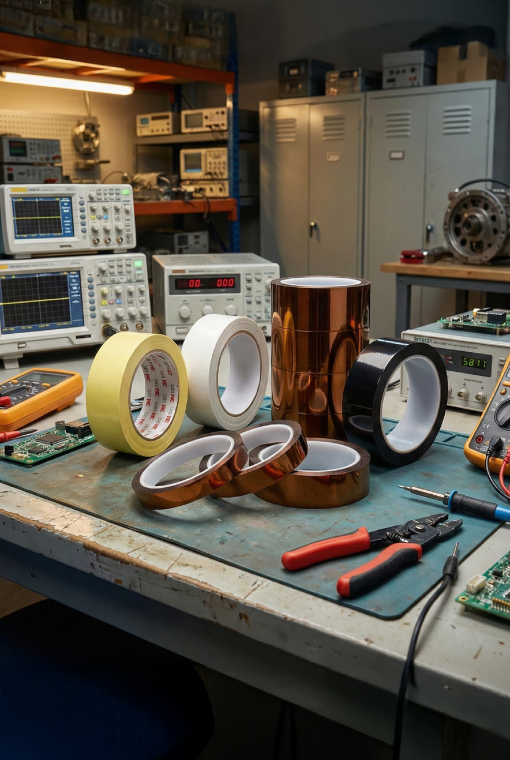
Foil and Insulation Tapes are specialized adhesive tapes designed for interference shielding, static dissipation, and electrical insulation. Used for wire wrapping, circuit shielding, metal surface coating, and high-stability applications. Manufactured from materials such as Aluminum Foil, Polyimide, Polyester, and Mylar.
Foil & Insulation Tapes Defined Specially for EMI / ESD and Electrical Work
Foil and Insulation Tapes (Polyimide / Polyester / Mylar) are specialized tapes for electrical and electronic applications that provide interference shielding (EMI), static protection or dissipation (ESD), and electrical insulation. They support real-world applications requiring heat resistance, flexibility, and stability in production lines.
Main Applications
Used for Shielding / Grounding / Interference Protection and Insulating Electrical Components in wiring, circuit boards, control cabinets, and electronic devices. Helps reduce leakage, shorts, and system noise problems.
Tape Structure
Consists of a Base Material (Aluminum Foil / Polyimide / Polyester / Mylar) for insulation or shielding properties, a Heat-Resistant Adhesive Layer for secure bonding, and a Release Liner to protect the adhesive surface before use.
Key Advantages
Excellent for Reducing EMI / Noise, Controlling ESD, True Electrical Insulation, High Heat Resistance, and Strong Adhesion even when bent. Helps increase stability, reduce waste, and improve assembly quality control.
Foil and insulation tapes are used for EMI Shielding, ESD Control, and Electrical Insulation. Tape performance depends on a "3-Layer Structure" working together seamlessly.
✓Carrier(Base)✓Adhesive(Layer)✓Liner(Release)
Carrier (Base Material)
The main structure of the tape. Defines Insulation / Shielding / Heat Resistance properties. Examples: Aluminum Foil (EMI), Polyimide (Heat Resistant), Polyester/Mylar (General Electrical).
Adhesive Layer
Controls bonding strength and stability. Must be heat resistant, non-bleeding, and stable. Some formulas support ESD and specific electrical applications.
Release Liner
Protects the adhesive surface before use. Facilitates easy peeling and precise positioning, reducing waste and increasing installation speed.
Before choosing a tape, consider "Electrical Properties + Heat + Adhesive Type + Thickness" alongside value and brand reliability for your specific site conditions.
Electrical Properties: "Insulating" or "Conductive" ▾
For insulation work, choose Polyimide / Polyester / Mylar. For EMI/Grounding, consider foil tapes or conductive specifications based on requirements.
Heat Resistance: "Non-Degrading" performance ▾
For PCB/Soldering, check the actual temperature range and exposure time to ensure the tape doesn't shrink, get brittle, and peels off cleanly.
Adhesive Type: Acrylic vs Silicone ▾
Acrylic excels in adhesion and environmental resistance. Silicone excels in heat resistance and clean removal. Choose based on the surface.
Thickness and Durability ▾
Related to tensile/tear strength and surface protection. For heavy use or frequent friction, increase thickness or strength.
Price Efficiency ▾
Not necessarily the cheapest; look for "lifespan value" to avoid peeling/rework and reduce waste.
Brand Reliability ▾
Reduces long-term project risks due to consistent specs, standard controls, and reduction of premature tape failure.
Real-World Applications of Foil & Insulation Tapes Across Industries
HVAC
|HVAC / Ducting Insulation
Seal Joints • Leak Prevention • Heat Reflection
Commonly uses Aluminum Foil Tape to seal joints and reflect heat for system stability.
Securely seals insulation/duct joints
Resistant to site moisture and temperature
Helps reduce system energy loss
EMI / ESD
|Electronics / Interference Protection
EMI Shielding • Grounding • ESD Reduction
Uses Copper Foil Tape for signal shielding/grounding and ESD control around critical components.
High conductivity, ideal for grounding
Reduces noise in enclosures/circuit boards
Supports precision component assembly
PCB
|PCB / Soldering Work
Masking • Heat Protection • Shape Retention
Ideal for Polyimide Tape (Kapton) in high-temperature tasks like soldering/reflow and area masking.
Extreme heat resistance during manufacturing
Clean removal, leaves no residue
Suitable for precision and small parts
Motor
|Motor / Transformer
Coil Wrapping • Insulating • Tensile Strength
Uses Polyester/Mylar Tape (PET/Mylar) for electrical insulation and secure component fastening in coil wrapping.
Durable, resists tension and friction
Suitable for general electrical insulation
Maintains clean coil shapes
Maintenance
|General Electrical / Maintenance
Wire Wrapping • Ending • Quick Site Work
Select PVC Insulation Tape for flexibility, ease of use, and budget-friendly general work.
Flexible, wraps well around corners
Suitable for maintenance and site work
Affordable and versatile
★ Advantages of Foil & Insulation Tapes
Key Benefits of Foil & Insulation Tapes (Advantages)
Foil and insulation tapes (Polyimide / Polyester / Mylar) are designed specifically for electrical and electronic work. They provide essential "Protection–Control" in critical areas such as electrical insulation, heat resistance, and EMI/ESD interference reduction for safer, more stable operations.
✔
Quick Summary of Benefits
Choose the right type, and electrical performance stabilizes immediately.
•Targeted EMI/ESD Protection — Foil tapes help shield signals, and some models support grounding/discharge.
•Electronic-Grade Heat Resistance — Polyimide is perfect for PCB/soldering, reducing shrinkage or brittleness.
•Clean Finish & Time Saving — Fast installation and precise placement reduce rework and long-term risks.
Tips & Recommendations
Always start by choosing "Insulating" or "Conductive"
If you need electrical insulation, look at Polyimide / Polyester / Mylar. If you need EMI shielding or grounding, consider foil tapes (like Aluminum/Copper) and check conductivity specs based on the job.
Wipe away all dust/oil and let dry before applying. This is critical for electrical/electronic work to ensure adhesion reliability and reduce peeling risks.
For high-heat (PCB/Soldering), check "Adhesive Type" and range
For heat-exposed work, choose tapes that don't shrink or get brittle and peel off cleanly. Check both the carrier (e.g., Polyimide) and adhesive type (Acrylic/Silicone) to match the process.
EMI work: Focus on "Grounding" and layer continuity
Foil tapes shield best when fully flush and properly grounded. Check joints/overlaps for continuity to avoid gaps that drop performance.
Technique for flat bonding: Apply pressure + Let adhesive set
Align tape correctly, apply even pressure for 10–20 seconds, and avoid immediate stress. Wait at least 24 hours for the bond to fully develop.
Right Tape Choice = Reduced Risk + Verified Quality Control
Foil and insulation tapes (Polyimide / Polyester / Mylar) are specifically designed for electrical and electronic work. They solve problems general tapes can't handle, such as extreme heat, EMI interference, ESD static, and long-term stability. Choosing the right specifications from the start reduces rework, minimizes waste, and increases the reliability of products in your production line.
Polyimide Film Tape 5413 features DuPont™ Kapton® polyimide film and silicone adhesive, used for PCB masking and high-temperature applications. It is resistant to chemicals and UV radiation. The tape is amber in color with a thickness of 2.7 mm.
Polyester tape Which is suitable for concealing in high temperature applications up to 120 degrees and adheres to the silicone coating surface well The tape has a silicone adhesive that acts as a mask and removes dirt from the surface.
Polyimide Tape 50um is a single-sided adhesive tape. Heat resistant Suitable for electrical work Electronics due to resistance to Corona discharge, the cause of ion formation Which causes loss of electrical insulation when the critical pressure reaches
MT PI80 Polyimide Tape 80um is a single-sided adhesive tape. Heat resistant Suitable for electrical work Electronics due to resistance to Corona discharge, the cause of ion formation Which causes loss of electrical insulation when the critical pressure reaches
MT PET60 is a single-sided, clear silicone tape with a thickness of 60 microns. It consists of a PET film backing and is coated with a clear silicone adhesive. It is suitable for electrical insulation and electronic components.






















.png)




 LINE @wetapestore Check stock / product inquiry
  Chat with Staff Live chat during business hours
  Request a Quote Send details for pricing
  Call Direct sales hotline


.png)
.png)
.png)


.png)
.png)
.png)
.png)
.png)